The central government's “No. 1 documents” for 2013 and 2014 explicitly proposed advancing rural ecological civilisation construction and sustainable development, promoting eco-friendly agricultural development, stepping up ecological conservation and construction efforts, and establishing a long-term mechanism for sustainable agricultural development. China has cumulatively issued multiple policy documents promoting the development of the organic industry, reflecting the state's high regard for ecological civilisation construction and sustainable agricultural development, as well as its policy support for the growth of the organic industry. Local governments at all levels also attach great importance to the development of the organic industry. Currently, many provinces in China have integrated the development of the organic industry with the protection of the rural ecological environment, the development of the rural circular economy, the resolution of issues relating to agriculture, rural areas and farmers through green barriers, and the building of a new socialist countryside. They have formulated organic industry development plans and a series of incentive policies, and implemented subsidies for organic product development, which have encouraged agricultural enterprises, rural professional cooperatives and farming households to establish organic production systems, significantly boosting their enthusiasm for organic production.
1.1 Latest developments in the domestic organic industry
In active response to the requirements of the “green development, building a resource-conserving and environmentally friendly society” set out in the 12th Five-Year Plan for National Economic Development, the domestic organic industry has carried out a series of activities to promote the development of the organic sector. These activities mainly include: to leverage the advantages of accreditation certification, in September 2014 the Certification and Accreditation Administration of the People's Republic of China (hereinafter referred to as cnca) held an “Organic Publicity Week” campaign, the newly revised Measures for the Administration of Organic Product Certification was officially implemented, the “organic product certification demonstration and creation” campaign has been organised since 2011, and important initiatives have been rolled out such as the implementation of the 12th Five-Year National Science and Technology Support Programme project on “Research and Demonstration of Key Technologies for Certification of Regional Advantageous and Characteristic Organic Products”
Work.
1.1.1 The new version of the Administrative Measures for Organic Product Certification was released and implemented.
On 15 November 2013, the General Administration of Quality Supervision, Inspection and Quarantine (hereinafter referred to as AQSIQ) issued the Measures for the Administration of Organic Product Certification (AQSIQ Decree No. 155). These Measures officially came into effect on 1 April 2014. Compared with the 2004 edition of the Measures for the Administration of Organic Product Certification, the main changes are in the following aspects:
Unify the certification scope and establish an organic product certification catalogue system. cnca successively published the Organic Product Certification Catalogue and the Supplementary Organic Product Certification Catalogue, and only products included in the catalogues can obtain organic certification.
(2) Establish a system for organic codes and certificate numbers, unifying certificate and certification marks. Establish a 17-digit organic code management system known as “one product, one code”, requiring the organic code to be used on the smallest sales packaging of certified products; establish a unified certificate numbering system, with all certification bodies issuing certificates based on system-generated certificate numbers. Both organic codes and certificate numbers can be queried through the cnca website, making it easy for consumers to verify the authenticity of organic products.
(3) The organic transition certification logo has been removed. However, organic transition certification still exists, and organic products must still undergo a 2 to 3-year transition period before receiving certification, during which transition-period products can only be sold as conventional products.
(4) Establish a sales certificate system for organic product certification to ensure products are not sold beyond the approved scope. To guarantee that the categories, scope, and quantities of organic products sold by the certification applicant are consistent with those in certificate, certification bodies are required to issue sales certificates to ensure sales do not exceed the approved scope.
(5) Regulating the supervision of imported organic products to protect the domestic market. Establishing an entry verification system for imported organic products helps protect the legitimate rights and interests of consumers in China and the healthy development of the domestic organic product market. To ensure the effective implementation of the supervision regulations for imports under the new Administrative Measures for Organic Product Certification, cnca organised the formulation of the Guidelines for Entry Verification Work of Imported Organic Products and required all entry-exit inspection and quarantine departments to implement them by reference.
(6) Increase penalties, establish an exit mechanism, and eliminate non-compliant enterprises. The new Administrative Measures for Organic Product Certification clearly stipulate the legal sanction grounds and specific measures for illegal acts committed by certification bodies and certification applicants.
Penalties, including punishment for forgery, alteration, fraudulent use, illegal trading, transfer, defacement certificate, and other acts. Under the new Measures for the Administration of Organic Product Certification, if a certification client provides false information, violates regulations by using prohibited substances, uses the organic certification mark beyond the approved scope, or experiences a major product quality and safety accident, certification bodies shall not accept organic product certification applications from the enterprise, its production bases, or processing facilities for a period of 5 years.
1.1.2 Organise Organic Promotion Week events
In order to implement the spirit of the 18th National Congress of the Communist Party of China regarding accelerating the development of modern agriculture and vigorously promoting ecological civilisation, comprehensively showcase the achievements of China's organic product certification system, popularise organic knowledge among the general public, and promote the healthy development of the organic industry, in accordance with the overall deployment of the national “Quality Month” campaign, cnca organised a series of “Organic Publicity Week” events. The main activities included:
(1) Publish a series of reports on the development of the organic industry in news media; broadcast a series of interviews and special programmes on organic product certification across newspapers, television, websites and other media outlets, systematically showcasing the achievements in the development of the organic industry and the establishment of organic certification demonstration zones.
(2) Hold the launch event for the "Report on the Development of China's Organic Industry" and the distribution campaign for a series of books on organic product certification. Release the "Report on the Development of China's Organic Industry" via news media and websites; distribute books such as the "Implementation Guide for Food and Agricultural Product Certification" and "Q&A on Organic Product Certification Knowledge" in communities, supermarkets, enterprises, schools and other venues; and organise activities such as online reading.
(3) Produce promotional posters and display windows (boards) for organic product certification. Organise the distribution and posting of promotional posters for organic product certification; create outdoor and indoor thematic promotional display windows (boards) for organic products in public places and office and living areas to foster a strong promotional atmosphere.
(4) Organise interactive consumer experiences by visiting organic bases. Arrange for consumers to visit organic bases to experience first-hand organic farming, processing and consumption processes, distribute organic promotional materials on-site, help consumers understand organic knowledge, and identify certified organic products. Organise media follow-up reports and produce special programmes.
(5) Host the online interview programme “My Organic Life”. Invite relevant experts, consumers, organic certification personnel, and organic producers and sellers to participate in an interactive online interview to promote organic knowledge and...
organic certification system, enhancing mutual trust among all parties in organic products.
(6) Organise public welfare activities such as “organic knowledge into communities” and “organic knowledge into campuses”. Organise local bureaus and certification bodies to hold “organic knowledge into communities” public welfare activities, promoting the concept of organic living through the distribution of organic certification publicity materials, expert consultation and explanations, organic physical lucky draws, etc.; organise organic product certification experts to go to schools (kindergartens) to explain organic product certification knowledge, promote the concept of organic living and consumption knowledge, and screen promotional videos for organic product certification. Screen promotional videos for organic product certification in the media, and broadcast videos on the cnca website and related websites.
(7) Hold a certificate-awarding ceremony for voluntary supervisors of organic product certification. Appoint members of the public as voluntary supervisors of organic product certification, organise them to actively participate in supervision, inspection and publicity activities, and strengthen social supervision.
(8) Launch a new media platform for organic product certification. Establish a public information new media platform for organic products to serve as a showcase for organic products and certification bodies, provide consumers with services such as organic product certificate logo query, organic knowledge popularisation, and organic consumption guides, offer organic certification demonstration zones a platform to promote local specialty industries, enable the public to obtain reliable and authoritative information on organic products, and resolve the bottleneck of information asymmetry.
(9) Intensive clean-up and rectification of the organic product certification market. Organise certification regulatory authorities across all regions to join forces with relevant functional departments to intensively carry out organic product certification regulatory enforcement activities, expose a batch of illegal and irregular cases regarding organic product certification, promptly respond to and handle public opinion information, and purify the market environment for organic products.
1.1.3 Continue to carry out the 2014 demonstration and creation campaign for home-use storage product certification and compliance
To fully play the role of certification accreditation “transmitting trust, serving development”, improve the regulatory linkage mechanism for organic product certification, use certification accreditation methods to promote local economic development, and drive the healthy and steady development of China's organic industry, cnca has been carrying out the “Organic Product Certification Demonstration Creation” work since 2011.
cnca instructs all recommending bureaus to continue to urge and assist demonstration zones for organic product certification creation to constantly improve the macro quality work mechanism of “the local government bearing overall responsibility, regulatory departments bearing their respective responsibilities, and enterprises being the primary responsible party”, and to do a good job in the demonstration and creation of organic product certification. At the same time, all recommending bureaus should strengthen the supervision and inspection of certification activities in the demonstration zones for organic product certification creation, and strictly investigate and punish organic demonstration creation
Illegal and irregular certification activities within the district should be dealt with by urging the relevant county or city governments to make rectifications if they can no longer continuously meet the application conditions, and management should be strengthened. If they still fail to meet the application conditions after rectification, a timely report should be made to cnca to revoke the title of “Organic Product Certification Demonstration and Creation District”.
Following recommendations selected by local quality inspection departments, cnca conducted documentary audit, expert consultation, and online public notice for the units that applied to carry out organic product certification demonstration creation for 2014, and agreed that nine counties and cities including Kaihua County in Zhejiang Province, Xinfeng County in Jiangxi Province, Lingbao City in Henan Province, Fan County in Henan Province, Chibi City in Hubei Province, Liangzi Lake District in Hubei Province, Lufeng County in Guangdong Province, Tongjiang County in Sichuan Province, and Guinan County in Qinghai Province should undertake the creation of national organic certification demonstrations.
1.1.4 Launch of the Eleventh Five-Year National Science and Technology Support Program Research Project: “Research and Demonstration of Key Technologies for Certification of Regional Advantageous and Characteristic Organic Products”
The National Science and Technology Support Programme project, “Research and Demonstration of Key Technologies for the Certification of Regional Advantageous and Characteristic Organic Products”, is the fourth project in the field of certification accreditation included in the 12th Five-Year National Science and Technology Support Programme. Closely adhering to the overall deployment of the national “12th Five-Year” Plan Outline and the “12th Five-Year” Plan for the Development of Certification accreditation Undertakings, the project is based on the key and difficult technologies in the production and processing engineering of regional advantageous and characteristic organic products for the development of China's organic industry. It innovatively establishes quantitative or semi-quantitative evaluation technologies related to the entire organic product industry chain, and creates ecological civilisation evaluation technologies with organic certification as the core. The project is divided into six topics, with a implementation period of three years, and is expected to be completed in 2016.
The project will achieve major breakthroughs in three key technologies: organic product evaluation and analysis technology, risk early-warning technology, and information traceability technology; research and establish stability comparison models for organically processed and conventionally processed products; draw national distribution maps of advantageous regions for organic production of products such as vegetables and tea; and build a supportive platform for the evaluation of substances permitted for use in organic products in China. It is expected to build 7 demonstration and creation zones, 2 maturity evaluation demonstration zones, formulate 12 national/industry standards, formulate 6 technical specifications, apply for 2 patents, develop 2 information software systems, publish 4 monographs, obtain 1 software copyright, publish 18 scientific research papers, complete 15 research reports, and train 6 academic leaders, 2 innovation teams, and 200 professional and technical personnel.
Since the 18th National Congress of the CPC explicitly proposed vigorously promoting the construction of an ecological civilisation, as an important component of the “five-sphere integrated plan”, the construction of an ecological civilisation has received widespread attention from all sectors of society. Ecological civilisation
Development must be integrated into all aspects and the entire process of economic, political, cultural and social development, with indicator systems relating to ecological civilisation serving as the foundation. Through research into key technologies for evaluation indicators concerning resource recycling, the ecological environment, ecological value and supply chain integrity in the development of the organic industry, this project will explore the role of organic product certification in ecological civilisation and the application of organic industry maturity evaluation to the development of ecological civilisation. The implementation of this project is of great significance for advancing China's ecological civilisation development and the modernisation of its national governance system.
1.2 New trends in the development of the domestic organic industry
1.2.1 Chinese organic agriculture explores new technologies and new development models for modern agriculture
With the rapid development of science and technology, emerging fields such as biotechnology, new materials technology, and information technology are rapidly improving people's quality of life and lifestyles, whilst also having a profound impact on the development of the agricultural industry. The development of organic agriculture relies on these novel bio-fertilisers, pesticides, and equipment as technological support, serving to reserve and practice new technologies for the development of modern agriculture. Furthermore, with economic development, people are paying more attention to the ecological and social functions of agriculture alongside its production function. Organic agriculture is a new type of ecological agricultural industrialisation development model or system established through improvements on traditional and conventional agriculture, balancing ecological, environmental, economic, and social benefits, and integrating production, management, distribution, and consumption through organic product labelling. Consequently, it can play a leading role in the ecological and environmental transformation of conventional modern agriculture.
1.2.2 Regional development of China's organic industry continues to expand
At present, the vast majority of organic product production bases in our country are distributed in the eastern coastal regions and the north-eastern provinces and regions. Over the past two to three years, the western region has taken advantage of the Western China Development strategy to develop organic animal husbandry, which has also shown a good momentum of development. In terms of quantity and area, the three northeastern provinces are the largest; in terms of product processing depth and quality control, eastern provinces such as Shanghai, Zhejiang, Shandong, and Jiangsu, as well as Beijing, hold a greater advantage. This is related to local consumption levels, market demand, and the pioneering and enterprising awareness of enterprises, as well as supportive policies from local governments. The development of the organic agriculture industry is also related to environmental conditions for production. Organic agriculture in western regions such as Yunnan, Guizhou, Xinjiang, Qinghai, Ningxia, and Gansu is expected to achieve rapid development by virtue of its environmental and resource advantages, as well as preferential industrial support policies gradually introduced by local governments. Among them, natural collected products, specialty regional products, land-intensive products, etc., have obvious advantages compared with eastern provinces. The rise of Guizhou's organic industry in recent years is a very good representative of this development trend. Meanwhile, the eastern provinces will continue to leverage their product chain and market advantages to maintain their lead in organic processed products and the expansion of international and domestic markets.
1.2.3 The farm scale of organic products in China will continue to expand.
Before the year 2000, organic products in China were mainly produced according to the demands of the international market, and almost all of them were exported abroad. According to cnca statistics, by 2004 the total output value of China's organic products industry was 2.22 billion yuan, of which the total export value was 1.24 billion yuan. Domestic export products mainly included soybeans, tea, vegetables, coarse grains, etc., and the export destinations were mainly the United States, the European Union, Japan, and Southeast Asian countries. Nearly 1 billion yuan of the remaining certified organic products entered the domestic market, with varieties including vegetables, tea, rice, coarse grains, fruit, honey, traditional Chinese medicinal materials, aquatic products, livestock and poultry products, etc. By 2013, China's export volume of organic products had increased to about 500 million US dollars, while the sales volume of organic products in the domestic market had grown to about 20 billion to 30 billion yuan. Given that the demand for organic products in both domestic and international markets is still continuously growing, coupled with the continued strengthening of state supervision and support for the organic industry, it can be expected that the domestic and international market sales of China's organic products will continue to show an increasing trend year by year for quite a long time in the future.
1.2.4 Regulation of China's intermediary industry is continuously strengthening
The organic industry regulatory system includes a standards system and a management system. The national standard for organic products is the general framework for regulating and restricting the production, processing, operation and certification of organic products, and is the fundamental guideline for the development of the organic industry. The General Administration of Quality Supervision, Inspection and Quarantine promulgated and implemented the Chinese national organic standard GB/T19630-2005 "Organic Products" in 2005, and revised the standard in 2011. cnca is based on laws and regulations such as the Certification accreditation Regulations of the People's Republic of China, the national standard for "Organic Products", the Administrative Measures for Organic Product Certification and the Implementation Rules for Organic Product Certification. It has integrated and optimised the current management systems for the production, processing, operation, consultation and certification of organic products, providing unified requirements and methods for the certification of organic products in China, strengthening daily supervision and comprehensive quality control of the organic industry, and thereby providing a strong regulatory guarantee to ensure the effectiveness and healthy, orderly development of China's organic product certification. Domestic consumers' trust in organic products in China continues to increase, and the international reputation of China's organic products is also constantly improving.
1.3 Current status of the international organic industry development
Statistics published in early 2015 by the International Federation of Organic Agriculture Movements (IFOAM) and the Research Institute of Organic Agriculture (FiBL) show that over 170 countries worldwide are currently engaged in the production of organic food and beverages. The certified land area has reached 43.1 million hectares (Figure 1-1), which is four times that of 1999. The countries with the top 10 largest organic farm areas are Australia, Argentina, the United States, China, Spain, Italy, France, Germany, Uruguay, and Canada. In some countries, such as Sweden, Austria, Switzerland, Finland, and Italy, the organic land area exceeds % of the arable land area. At present, the main markets for organic food trade are in Europe (EU countries and Switzerland), the United States, and Japan. Figure 1-2 illustrates the current global organic agriculture production area and its regional distribution.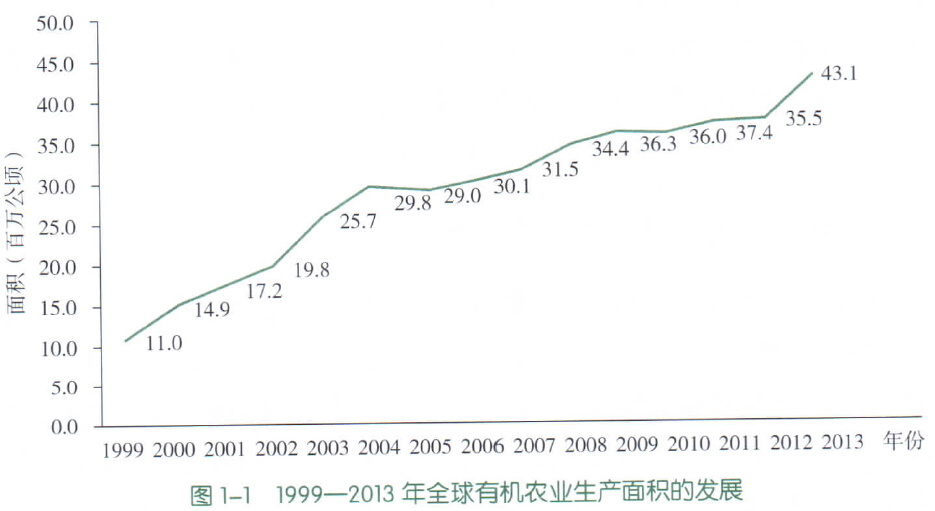 文章源自FOFCC-http://fofcc.org.cn/en/11579/
Global sales of organic food and drink reached 72 billion US dollars in 2013, which was already five times the figure for 1999. The top three consumer countries for organic products in 2013 were the United States, Germany, and France. Of these, the United States accounted for 43% of the global consumer market, and the European Union accounted for 40%.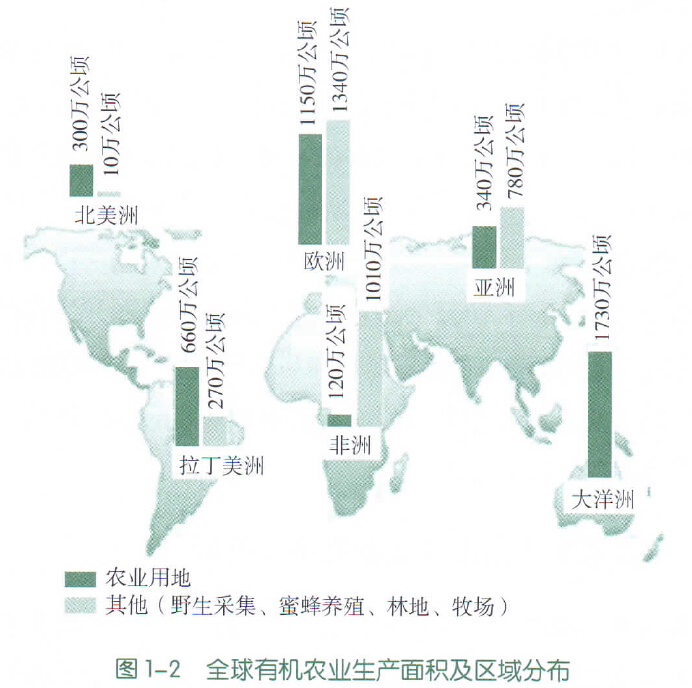 文章源自FOFCC-http://fofcc.org.cn/en/11579/
1.4 New trends in the development of the international organic industry
Since the beginning of the 21st century, while organic agriculture in developed countries has continued to see significant development, it has begun to show a gradually plateauing trend, whereas the demand for organic products, particularly organic food, has continued to grow. Under such circumstances, developed countries' demand for organic products from developing countries has continued to increase, thereby intensifying their efforts to import organic products from developing countries. Concurrently, in some relatively fast-developing nations, a demographic with a fairly strong demand for organic products has also emerged, promoting the initiation and development of domestic organic product markets, especially organic food markets, in developing countries. Under these circumstances, the organic agriculture and organic product sectors in China and some other developing countries have shown a momentum of rapid development.
More than 80 countries worldwide have already established standards or regulations for organic agriculture. Governments have used legislation to regulate organic agricultural production, which has enhanced public awareness of ecology, the environment, and health.,
The demand scale for organic products has been expanded, and organic agriculture has achieved unprecedented development in research, production, and trade.
The rise and development of domestic organic product markets in some developing countries signifies the comprehensive unfolding of the global organic cause and carries profound historical significance. Although compared with the market share of developed countries, the domestic organic markets of developing countries account for a relatively low share of the global organic market and have not yet exerted a significant impact on the global organic product market, the world's organic cause has nevertheless entered a stage of comprehensive unfolding and relatively stable development. Since developed and developing countries still need a process of adaptation and coordination in areas such as certification and market access, and developing countries also need a process of gradually standardizing and further aligning with international practices in developing organic agriculture and organic product markets, the current stage will continue for a long period of time. Global organic agriculture is developing vigorously, and its main development trends are manifested in the following aspects.
1.4.1 Global organic production and market demand will continue to grow.
As countries' awareness and acceptance of organic products increase day by day, more and more farmers will shift to organic production to meet market demand for organic products. The growth of the global organic market will be a major trend. In some major organic agricultural product producing countries, such as Argentina, Brazil, and China, domestic organic consumer markets are also gradually taking shape. Organic products will enter mainstream sales channels, and the main consumer group will be middle- and upper-class people pursuing high-quality and healthy food. Some large food companies, such as McDonald's and Nestle, have also entered the organic field. All of this indicates that organic agriculture is continuously growing worldwide, and organic products will increasingly appear in shops and on dining tables around the world.
1.4.2 From concern for environmental protection to attention to food safety
The main purpose of the early development of organic agriculture was to protect the environment and address the issue of sustainable agricultural development. Since the 1990s, especially since the outbreak of bovine spongiform encephalopathy (mad cow disease) in Europe, consumers have shifted their concern from environmental issues to food safety issues. In Germany, although sales of beef produced by conventional methods have declined by 50% in recent years, sales of organic beef have increased by 30%. Purchasing organic beef requires paying at least 30% more than purchasing conventional beef, but customers generally believe that because organic beef production entails more environmental and safety costs, paying a higher price is worthwhile. According to surveys, 56% of U.S. citizens believe that organic food is healthier; 60% of Danes frequently buy organic vegetables and milk; 30% of the bread on the market in Munich, Germany, is organic. As consumer demand increases for high-quality organic food, especially organic foods with relatively high market shares such as fruits and vegetables, infant and toddler foods, grains, and dairy products, the organic food market will grow steadily.
1.4.3 The emergence and coordination of global trade barriers
At present, more than 80 countries around the world have established their own differing certification and accreditation systems. Different systems affect the trade process of organic products among countries and violate the original intention of organic regulations, namely to increase trade, develop markets, and cultivate consumer confidence. The existing different standards and regulations have created technical barriers to trade, forcing many organic producers to obtain multiple organic certifications in order to enter different markets. Therefore, international institutions and organizations such as the United Nations Conference on Trade and Development (UNCTAD), the Food and Agriculture Organization of the United Nations (FAO), and the International Federation of Organic Agriculture Movements (IFOAM) are actively working toward harmonizing organic regulations among countries and institutions, in order to avoid potential trade barriers and promote free trade in global organic products.
1.4.4 Improvement of statistical work
Global organic agricultural production and the share of organic products will continue to grow. In order for policymakers to obtain more accurate statistical data to facilitate policy formulation, European governments and relevant institutions will invest more energy in further improving and perfecting statistical work on various aspects of organic agriculture.
At present, quite a few institutions have been continuously working on statistical data for organic agriculture, including Germany's Central Market and Price Reporting Office (ZMP), the United Kingdom's Institute of Rural Sciences (IRS), and Switzerland's Research Institute of Organic Agriculture (FiBL). At present, these three institutions are working hard to build a public database and will release relevant data on organic agriculture to the public through media such as the Internet. The collection and processing of organic market data are even more difficult. At present, the EU information system is carrying out a project on the organic market (www.eisfom.org), dedicated to providing more effective tools to improve the reliability of data analysis, so as to provide policymakers and traders with accurate market information.
1.4.5 Strengthening of policy support
Because of the positive significance of organic agriculture for health and the environment, organic agriculture has gained widespread recognition globally. Especially in Europe, in just over 20 years, organic agriculture has transformed from a previously secondary form of agriculture into a highly prominent form of agriculture. In order to ensure the sustained and stable development of organic agriculture, European governments and private institutions will cooperate more closely to steadily advance the European organic agriculture action plan and other policies related to organic agriculture. The United Kingdom has expanded the proportion of organic farmland, raising the target to 30%, and setting the market share at 20%. Although there may be some unforeseen factors constraining these targets, as long as a clear direction is set, it will certainly be beneficial to the sustained development of organic agriculture, and the proposal of such clear indicators can further increase public attention. Based on the current development levels of various countries, it is estimated that the proportion of organic farmland in the entire European Union can reach 25% by 2030.
文章源自FOFCC-http://fofcc.org.cn/en/11579/