5.1 Production status of organic products imported into China
Chinese imported organic products refer to organic products that are produced and certified in overseas production areas in accordance with Chinese organic product standards and imported into China. The market demand for organic products in China is continuously increasing, with a growing number of foreign enterprises wanting to import their organic products into China, and the area of overseas certification for Chinese organic products is also expanding.
In 2014, a total of 10 certification bodies carried out overseas certification, issuing 121 organic certificates and certifying 66 enterprises. Among the bodies conducting overseas certification, the top five in terms of the number of certificates issued were Hangzhou Wantai, Nanjing Guohuan, CQC, China Quality Certification Centre, and ECOCERT Beijing. These 10 certification bodies carried out organic certification in 20 countries overseas. The countries with the highest number of certificates and enterprises obtained were Italy, followed by Spain, Austria, Denmark, Australia, the United States, New Zealand, Germany, and Thailand (Figure 5-1).
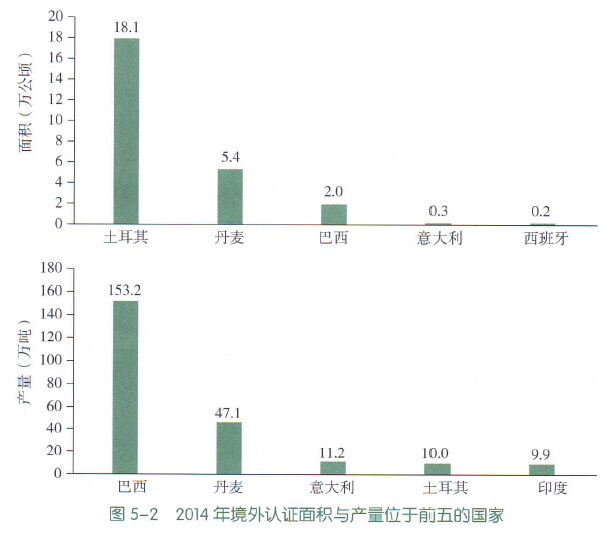
The total area of overseas certification for Chinese organic products is 265,000 hectares, of which Turkey accounts for 181,000 hectares. The product certified in Turkey is pomegranates, accounting for 68.3% of the total overseas certified area. Next is Denmark with 54,000 hectares, accounting for 20.4%; Brazil with 20,000 hectares (sugarcane production), Italy with 3,000 hectares, and Spain with 2,000 hectares (Figure 5-2). The combined organic certified cultivation area of 11 countries including France, Chile, and India is 5,000 hectares. Austria, Germany, the UK, and Switzerland only have processed products, with an organic certified cultivation area of zero.
In 2014, the total certified production outside China stood at 2.499 million metric tonnes, of which Brazil’s certified production amounted to 1.532 million metric tonnes, primarily comprising organic sugarcane, accounting for 61.31 per cent of the total certified production outside China;Denmark followed with 471,000 metric tonnes, accounting for 18.81 per cent; the products produced in Denmark were mainly dairy products; Italy, Turkey and India ranked third to fifth. The combined output of these five countries accounted for 92.61 per cent of the total output (Figure 5-2).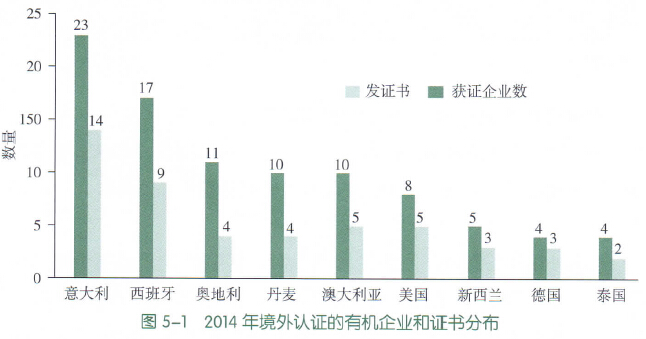 文章源自FOFCC-http://fofcc.org.cn/en/11575/
The total area of overseas certification for organic products in China is 265,000 hectares, of which the organic planting area is 207,000 hectares, the fruit planting area is 185,000 hectares, accounting for 69.9% of the total area, livestock and poultry (pasture area for milk farming) is 58,000 hectares, accounting for 21.8%; and the planting area for sugar-producing plants is 21,000 hectares, accounting for 7.9% (Table 5-1).
There are 50 varieties of organically certified products from overseas, of which 27 are processed products. The total output of organically produced goods from abroad is 2.499 million tonnes, with sugar plants accounting for 1.536 million tonnes, representing 78.0% of the total overseas organic produce, while processed products amount to 289,000 tonnes, mainly consisting of wine, vegetable oil, and condiments.
5.2 Production status of organic products exported by China
The analytical data used in this report were provided by six foreign organic certification bodies: ECOCERT from France, BCS from Germany, CERES from Germany, JONA from Japan, IBD from Brazil, and BAC from Italy. The data information includes categories of exported agricultural products, trade volumes, trade values, and exporting countries for 2014. The products analysed in this section are those produced and traded in accordance with foreign standards (primarily including those of the European Union, the United States, Japan, Australia, and other countries).
According to statistics, based on foreign standards, there were 1,198 cattle producers, 1,037 production bases, and 698 organic product processing plants. In 2014, products certified according to foreign organic standards mainly included plant products, livestock and poultry products, processed products, and aquatic products. The total certified organic cultivation area was 1.1138 million hectares, of which 0.8007 million hectares were organically certified area, and 328,400 hectares were wild collection area. In 2014, the total output of certified plant products was 3.3586 million tonnes (58.47%), processed products 2.2754 million tonnes (39.62%), livestock and poultry products 0.1072 million tonnes (1.87%), and aquatic products 0.0025 million tonnes (0.04%).
5.2.1 Production status of bamboo and wood products
In 2014, plant products certified according to foreign standards included cereals, vegetables, fruit, and nuts. The total certified area was 800,700 hectares, of which organically certified area was 779,300 hectares (97.33 %) and conversion certified area was 21,400 hectares (2.67 %). The total certified production was 3,263,300 tonnes, of which organically certified production was 3,160,800 tonnes (96.86 %) and conversion certified production was 102,500 tonnes (3.14 %) (Table 5-2).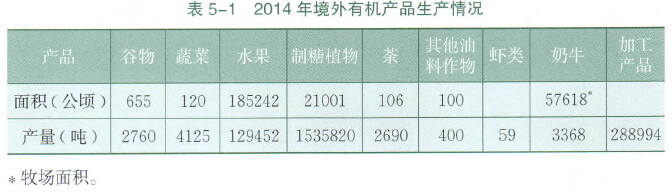 文章源自FOFCC-http://fofcc.org.cn/en/11575/
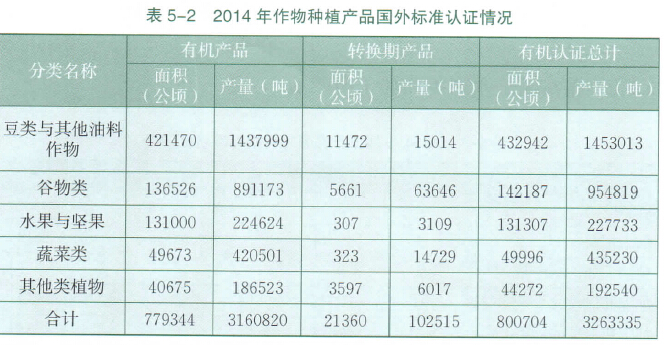
Among all cultivated crops, pulses and other oilseed crops have the largest cultivation area at 432,900 hectares, followed by cereals at 142,200 hectares and fruit and nut crops at 131,300 hectares. The cultivation area for vegetable products is 50,000 hectares. Corresponding to the area, cereal production also ranks first at 1,893,800 tonnes (56.62%); pulses and other oilseed crops rank second at 514,000 tonnes (15.37%); and vegetables rank third at 435,200 tonnes (13.01%). Comparing the data from 2013 and 2014, apart from a slight decrease in the cultivation area of cereal products, the cultivation areas of other products have increased slightly. Overall, the total area for organic cultivation according to foreign standards has not changed much, remaining basically around 800,000 hectares (Figure 5-3).
In terms of both area and output, plant-based products are predominantly cultivated, with wild collection accounting for a relatively small proportion. The area of wild collection stood at 328,400 hectares with an output of 156,600 tonnes. The plant products obtained through wild collection were mainly fruit and nuts, plant-based traditional Chinese medicines, pulses and other oilseed crops, and other plant categories.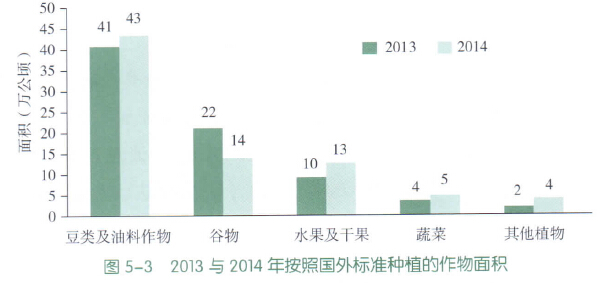 文章源自FOFCC-http://fofcc.org.cn/en/11575/
5.2.2 Livestock and poultry meat, aquatic products, and processed products文章源自FOFCC-http://fofcc.org.cn/en/11575/
In 2014, the total certified output of livestock and poultry products was 107.2 thousand tonnes, with the principal certified animal product being cows' milk at 86.4 thousand tonnes, accounting for 80.60% of the total livestock and poultry output. Other animal products amounted to 14.8 thousand tonnes, principally eggs, accounting for 13.87% of livestock and poultry products. Live animals mainly comprised goats, pigs and chickens, totalling over 5,000 tonnes. Aquatic products only included certified seaweeds and seagrasses, with an output of 2,470 tonnes.
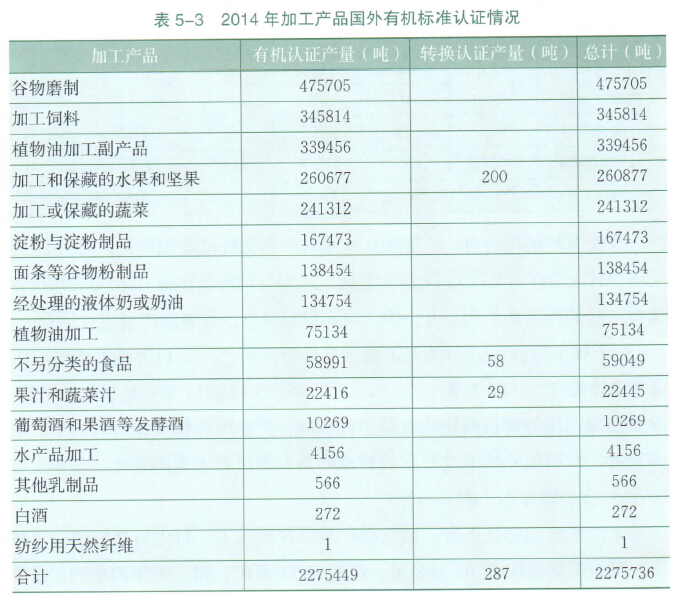
In 2014, processed products from China applying for foreign organic standard certification fell into 16 categories, including grain milling, processed feed, and vegetable oil processing by-products (Table 5-3). The total output of processed products was 2,275,700 tonnes, of which organically certified output was 2,275,400 tonnes, accounting for 99.99%, while transitional certified output was very small at just 300 tonnes.
The production of milled grain was the highest at 475.7 thousand tonnes, accounting for 20.90% of the total output of processed products. This was followed by processed animal feed, by-products of vegetable oil processing, processed and preserved fruits and nuts, and processed or preserved vegetables. The production of these five categories accounted to 73.08% of the total output. Starch and starch products, grain mill products such as noodles, treated liquid milk or cream, vegetable oil processing, and unclassified foods each accounted for less than 10%. The proportions for fruit and vegetable juices, fermented beverages such as wine and fruit wine, processed aquatic products, other dairy products, baijiu and natural fibres for spinning were very small, each accounting for less than 1%.
文章源自FOFCC-http://fofcc.org.cn/en/11575/